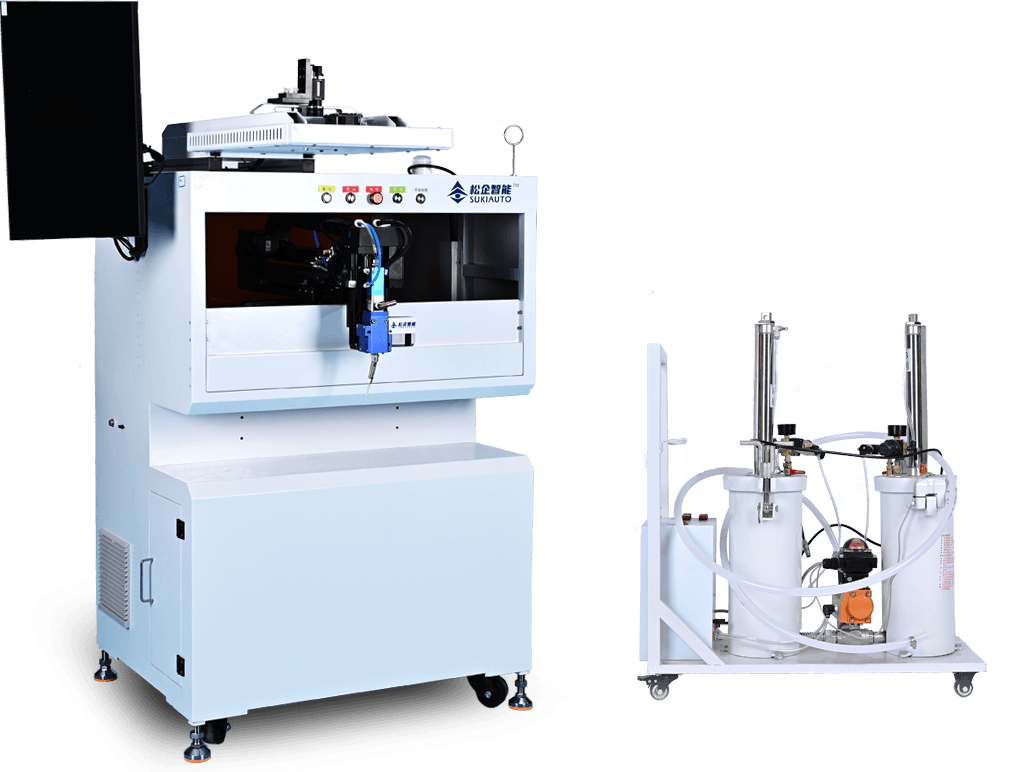
An in-depth analysis of the principles of vision-following dispensing technology, its core differences from conventional dispensing, application scenarios and future trends—with equipment selection and ROI reference. Original technical explainer from SukiAuto.
Introduction: In high-precision manufacturing fields such as 3C electronics, new-energy vehicles and semiconductor packaging, the "dispensing" process has long been regarded as a bottleneck constraining capacity and yield. Vision-Guided Following Dispensing—a process route that deeply fuses machine vision, motion control and fluid technology—is reshaping the process logic of the automated workshop. Starting from the technical principles, a multi-dimensional comparison with conventional dispensing, typical applications and future trends, this article provides an actionable cognitive map for process engineers, equipment buyers and manufacturing managers.

Across China's manufacturing landscape, tens of thousands of factories focused on PCBA, battery modules and precision structural parts are clustered in Dongguan, Suzhou and Shenzhen. On the lines of these factories, there is almost always an unobtrusive yet globally influential process—dispensing.
Whether it is fixing shielding cans on phone motherboards, sealing and potting the top cover of a power-battery pack, or bonding a smartwatch frame to glass, all rely on dispensing to achieve the composite functions of "electrical insulation + structural bonding + conformal protection." Yet over the past three decades, the dispensing process has long lagged behind overall line takt in precision, consistency and flexibility:
It is precisely these "four bottlenecks" that gave rise to the vision-following dispensing process paradigm. Since its founding in 2018, Dongguan SukiAuto Intelligent Technology Co., Ltd. has continuously深耕 this direction, with a customer repurchase rate over 83.2% and efficiency more than 20% higher than market competitors at the same price point. This article uses SukiAuto's product practice as a reference frame to break down the technical core of vision-following dispensing.
Vision-following dispensing is a process in which, without the need for precision fixtures, an industrial camera recognizes the pose of moving workpieces on the line in real time, and the motion-control system drives the adhesive valve to dispense along the product outline with dynamic following.
The key is that the four actions of "recognize — correct — follow — dispense" close the loop within a millisecond-scale time window.
| Module | Hardware/Software | Core role |
|---|---|---|
| Vision sensing | 5MP color industrial camera (e.g. Hikvision), custom flicker-free LED light source | Captures workpiece images within a 320×256mm field of view and recognizes positioning datums |
| Motion execution | Full-steel KK module + AC servo motor + self-developed motion control card (YMC-08-01) | Achieves high-precision X/Y/Z/R four-axis coordination |
| Algorithm hub | SukiAuto self-developed vision-following software | Image processing, coordinate transform, trajectory interpolation, dispensing-process dispatch |
| Fluid control | Dual-barrel adhesive supply, low-material alarm, screw-pump/gear-pump metering, suck-back valve | Ensures stable output, clean cutoff, no residual adhesive |
Line encoder trigger → Camera capture → Vision software locates workpiece pose
↓
Motion control card converts vision coords to real-time valve trajectory
↓
Servo motor drives the valve to dynamically follow the moving product on the machine
↓
Valve precisely dispenses/draws adhesive on the workpiece surface
↓
Workpiece leaves the dispensing zone, system auto-releases the next piece
The per-piece cycle can be compressed to the second level, with very low end-to-end vision-to-motion latency—the engineering foundation that makes "silky following" possible.
| Dimension | Ordinary vision dispensing | Panoramic vision dispensing | Vision-following dispensing |
|---|---|---|---|
| Is the workpiece moving? | Stationary dispensing | Stationary or low-speed belt | Dynamic following on the conveyor |
| Vision system | Single-point / small-FOV camera | Large-format line-scan or area-array panoramic camera | Small-FOV area-array camera + high-speed dynamic recognition |
| Manual loading/unloading needed? | Yes | Partially | No |
| Relies on precision fixtures? | Mostly yes | Depends on precision needs | Fixture-free |
| Line-takt integration | Bypass operation | Semi-embedded | Embedded integration |
| Typical products | Single-point dispensing, fixed trajectory | Large-format flat PCB, automotive interior | High-mix low-volume, continuous line |
| Changeover flexibility | Low | Low (tied to program & camera FOV) | High (vision self-adaptation) |
This is the key dividing line for judging how "intelligent" a dispenser is. Vision-following dispensing is currently the process paradigm that best balances "precision + flexibility + takt" in the automated workshop.
From the four dimensions of "precision, efficiency, adaptability, cost," SukiAuto compares vision-following dispensing against conventional manual, semi-automatic and ordinary-vision dispensing as follows:
| Metric | Manual dispensing | Semi-auto dispensing | Ordinary vision dispensing | SukiAuto vision-following dispensing |
|---|---|---|---|---|
| Bead-width tolerance | ±0.05mm+ | ±0.03mm | ±0.02mm | ±0.02mm |
| Repeat positioning accuracy | Depends on operator | ±0.03mm | ±0.02mm | ±0.02mm |
| Vision recognition accuracy | N/A | N/A | ±0.20mm | ±0.15mm |
| Overflow/miss dispensing rate | 5%+ | ~3% | ~1% | <0.5% |
| Cost dimension | Conventional solution | Vision-following dispensing |
|---|---|---|
| Fixture cost | Thousands to tens of thousands of yuan per set | Approaching 0 |
| Labor replacement per machine | N/A | 1 machine replaces 1–2 skilled operators |
| Software licensing | Third-party may incur Halcon-like license fees | No hidden license fees |
| Payback period (Pearl River Delta) | N/A | 6–12 months |
Based on SukiAuto's real-world deployments in PCBA, power, acoustics and new-energy industries: under typical volume-production scenarios, the ROI cycle of one vision-following dispenser can usually be shortened to 6–12 months (varying with product complexity and capacity scale).
Vision-following dispensing technology is not a "concept gimmick"—it has already achieved scaled deployment across multiple industries that demand high consistency.
Take the shielding-can dispensing station of a PCBA factory served by SukiAuto (based on a typical-scenario estimate): after deploying the GP-26-740 embedded vision-following dispenser, operators were大幅 reduced (only inspection patrols needed), per-piece takt improved markedly, and yield rose from about 96% to over 99%, recovering the equipment investment within months.
Conventional vision algorithms rely on feature extraction and template matching, and still need manual teaching for new products. In the next phase, deep-learning-based vision models will enable "zero-teaching" or "few-shot teaching"—after a new workpiece comes online, the algorithm auto-learns product features and generates the trajectory.
Vision-following dispensing will no longer be an isolated machine; it will form "cell-level" line units together with loading, inspection, labeling, AOI and robotic palletizing. Machines interconnect via industrial protocols such as OPC-UA, Profinet and CC-Link, writing process data back to MES.
Dispensing, spraying, potting, labeling and AOI inspection will gradually merge onto one platform—a single machine completes the "recognize + dispense + inspect" trinity, further compressing takt and line footprint.
Over the next 3–5 years, leading vendors such as SukiAuto will release standardized models with "factory pre-calibration + one-button on-site start," compressing the time from unboxing to powered-up dispensing to within 2 hours.
Over the past decade, the high-end vision-dispenser market has long been dominated by German and Japanese brands. As domestic vendors like SukiAuto achieve self-controllable core components in algorithms, servos and control cards, the market penetration of domestic vision-following dispensers will keep rising.
Vision-following dispensing is not a single-point technology refresh; it is the result of coordinated evolution across vision sensing + motion control + fluid process + industrial software. For the first time it gives the dispensing process the ability to "see the workpiece, read the process, keep up with the takt," fundamentally unleashing the flexibility potential of the manufacturing line.
For manufacturers planning an automation upgrade, adopting vision-following dispensing is rarely a "whether to do it" question—it is a "when, and with whom" timing question.
Dongguan SukiAuto Intelligent Technology Co., Ltd. is headquartered in Dongcheng Subdistrict, Dongguan, Guangdong (Daotong Zhigu), with a branch in Shanghai, and serves customers across China and Southeast Asia. We offer free process-solution design + free sample testing, plus 1V1/1V2 dedicated after-sales service, 7×24 response, lifetime maintenance and periodic follow-up.
If you are evaluating a vision-following dispenser, inline potting equipment or a selective conformal-coating solution, reach out via the channels below—our engineering team will respond within 15 minutes.
| Model | Type | Typical application |
|---|---|---|
| GP-26-740 | Embedded vision-following dispenser | Line bypass embedding, fixture-free dispensing |
| RX-26-740 | Cabinet vision-following dispenser (with fixed-point) | Hybrid dispensing scenarios |
| Inline potting machine | AB adhesive dual-fluid potting | LED light strips, sensors, battery modules |
| Selective conformal-coating machine | PCB coating | Home-appliance control boards, automotive electronics, LED drivers |
| Slot-die coater | Ultra-thin coating | Labs, pilot lines, medical electronics |
This article is original work of the SukiAuto technical team. To reprint or cite, please contact service@sukiauto.cn for authorization.